

Hospice Care in Wisconsin
Compassionate palliative and hospice care from a family-owned team, with support for your whole family along the way.

Compassionate palliative and hospice care from a family-owned team, with support for your whole family along the way.

Castle Senior Living provides hospice care in Wisconsin for people with a serious illness who want comfort, dignity, and time with the people they love. Our Medicare-certified hospice team cares for the whole person, including their medical, emotional, and spiritual needs, and supports your family through every step. When you call, you’ll hear back quickly, and you’ll always know who to reach.
If you’re reading this because someone you love is seriously ill, we’re sorry you’re facing it. You don’t need to have everything figured out before you call. Our team can answer your questions, explain your options, and help you decide on next steps at your own pace.
Hospice care is end-of-life care focused on comfort. It’s for people whose doctor expects they have six months or less to live if the illness follows its usual course, and who have chosen to focus on quality of life over curative treatment. Palliative care also focuses on comfort and symptom relief, but it can begin at any stage of a serious illness, even alongside treatment.
When it starts
Palliative care
Hospice care
When it starts
Any stage of a serious illness
When life expectancy is about six months or less
Treatment
Can continue curative treatment
Focuses on comfort in place of curative treatment
Goal
Relief from symptoms and stress
Comfort, dignity, and quality of life for the time that remains
Family support
Help with decisions and planning
Caregiver support, plus grief support after a loss
Many families move from palliative care to hospice over time. Our team can help you understand which option fits your loved one right now.
Castle Senior Living Hospice comes to wherever your loved one calls home. Wherever they are, the focus is the same: keeping them comfortable.

At a Castle community
Residents of The Grand Hills Castle and Birchrock can receive hospice care without moving, surrounded by the staff who already know them.

At home
In-home hospice care lets your loved one stay in familiar surroundings, with our team visiting regularly and a nurse available by phone day and night.
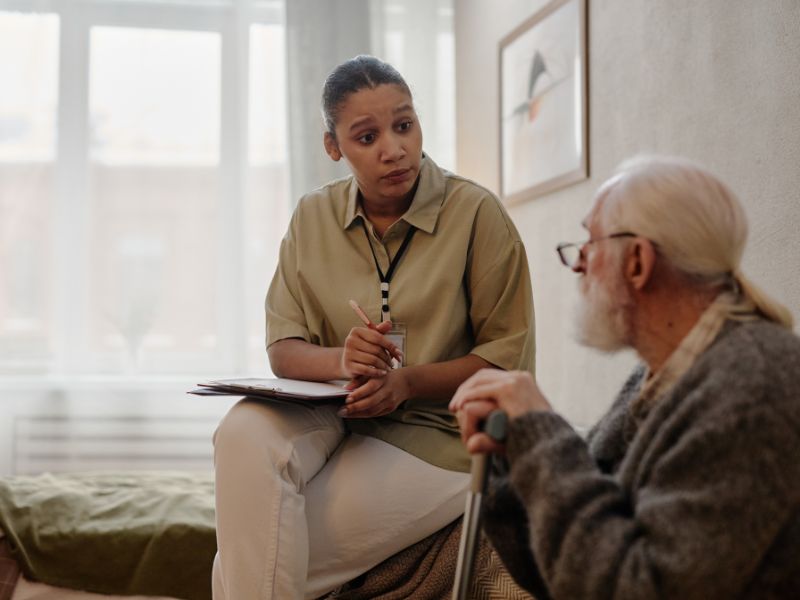
In nursing homes and assisted living communities
We also provide hospice care in nursing homes and other assisted living communities, working alongside their staff so your loved one gets the support they need.
Our hospice team is a small, close group that gets to know your loved one and your family. Someone is always available, day or night.

Hospice care for dementia takes a particular kind of attention. People in the later stages of dementia often can’t say when they’re in pain or uncomfortable, so our team watches for other signs, like changes in sleep, facial expressions, restlessness, or appetite, and responds to them.
Castle has cared for people with dementia for more than 25 years, and our memory care program, A Smile to Remember, shapes how we approach hospice too. We keep routines steady, use music and familiar voices to bring comfort, and help families find ways to connect when words are harder to come by.
Yes. A hospice nurse is available by phone 24 hours a day, 7 days a week, and can come out for a visit when your loved one needs one. If symptoms become hard to manage at home, Medicare also covers short-term continuous care, where a nurse or aide stays with your loved one for extended hours until things are under control.
Questions at 2 a.m. are welcome. Call our hospice team any time at (414) 930-4432.
There’s no perfect moment to ask about senior hospice care, and it’s never too early to ask questions. Families often reach out when they notice some of these:
Talking with our team doesn’t commit you to anything. And if your loved one’s health improves or they decide to try a new treatment, they can leave hospice care and return later if needed.

Once enrolled, all care related to the terminal illness is covered. Patients retain the right to change their minds and resume treatments.
Castle Hospice staff can assist in navigating insurance questions and paperwork.
“Castle Hospice was truly amazing. They showed sincere compassion and caring for my dad, who was suffering from cancer. There were many people involved with my dad from the hospital and senior facilities. Castle really stood out as the most caring and comforting. I highly recommend them.”
“Every individual from Castle Hospice was compassionate, supportive, and caring.”
Castle Senior Living, Inc. complies with applicable Federal Civil Rights Laws and does not discriminate on the basis of race, color, national origin, age, disability, or sex. Castle Senior Living does not exclude people or treat them differently because of race, color, national origin, age, disability, or sex.
Castle Senior Living provides free aids and services to people with disabilities to communicate effectively with us, such as qualified sign language interpreters and written information in other formats (large print, audio, accessible electronic formats, other formats).
Castle Senior Living provides free language services to people whose primary language is not English, such as qualified interpreters and information written in other languages.